
DTF & Shop Cost
DTF Cost Calculator (Basic · Standard · Advanced)
DTF cost per transfer: film, ink, powder, waste, labour — Basic & Advanced.
New here? Jump to how it works · FAQ
How detailed?
Basic = fastest path. Standard = more control. Advanced = full shop detail.
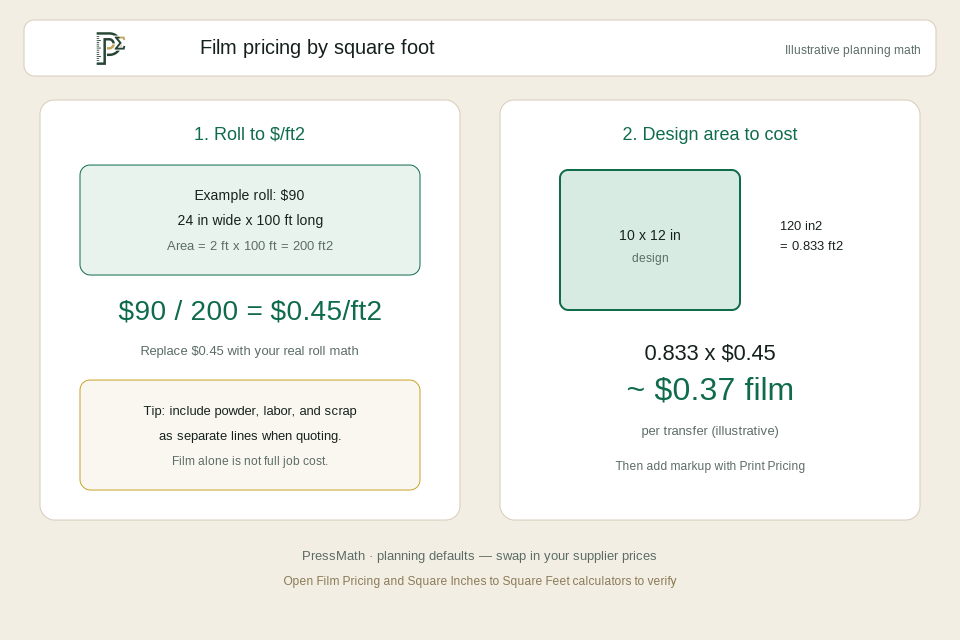
Direct answer: DTF unit cost ≈ (design area × film $/ft²) + ink/powder + waste buffer + labour share. Example planning path: 10×12 in ≈ 0.833 ft²; at $0.45/ft² film alone is ~$0.37 before ink, powder and labour. Then apply markup — do not copy a Facebook transfer price without your real costs.
Choose how detailed you want to go — you are not forced into every field.
Basic — design size + film $/ft², lump ink/powder/labour, waste, markup.
Standard — film from roll + CMYK/white ml + powder g + labour rate + target margin (no overhead stack).
Advanced — Standard plus electricity, overhead, maintenance, packaging and scenario compare.
Results are planning estimates — verify against supplier invoices and press logs.
How it works / formula
Calculation steps
- Basic mode
- Design area (ft²) = (width × height) ÷ 144
- Film cost = area × film $/ft²
- Materials = film + ink + powder
- Waste buffer = materials × waste %
- Unit cost = materials + waste + labour
- Suggested sell price = unit cost × markup (default 2.5×)
- Standard mode
- Same as Advanced materials (roll film, CMYK/white, powder, labour) with margin pricing — without electricity, overhead, maintenance or packaging.
- Advanced mode
- Film $/ft² from roll = roll price ÷ ((roll width in ÷ 12) × roll length ft)
- Film cost = design area ft² × film $/ft² from roll
- CMYK ink cost = (CMYK ml ÷ 1000) × CMYK $/L
- White ink cost = (white ml ÷ 1000) × white $/L
- Powder cost = (powder g ÷ 1000) × powder $/kg
- Labour = labour $/hr × (press seconds ÷ 3600)
- Electricity = (watts ÷ 1000) × (press seconds ÷ 3600) × $/kWh
- Materials = film + CMYK + white + powder
- Waste buffer = materials × waste %
- True unit cost = materials + waste + labour + electricity + overhead + maintenance + packaging
- Suggested sell price = true unit cost ÷ (1 − target margin %)
Worked example
Example (illustrative)
- Basic mode example
- Design: 10 × 12 in → 120 in² → 0.833 ft²
- Film at $0.45/ft² ≈ $0.37
- Ink $0.35 + powder $0.15 = $0.50
- Materials ≈ $0.87 → with 10% waste ≈ $0.96
- Plus $0.75 labour → about $1.71 unit cost
- Suggested sell at 2.5× markup → about $4.28
- Standard/Advanced example
- Same 10 × 12 in design (0.833 ft²)
- 24 in × 100 ft roll at $45 → film ≈ $0.225/ft² → film ≈ $0.19
- CMYK 1.2 ml at $80/L ≈ $0.10; white 2.5 ml at $90/L ≈ $0.23
- Powder 3 g at $18/kg ≈ $0.05
- Materials ≈ $0.56 → 10% waste ≈ $0.06
- Labour 15 sec at $18/hr ≈ $0.08
- Standard ≈ $0.70 before margin pricing; Advanced adds electricity/overhead/maintenance/packaging.
Assumptions & limitations
This calculator provides an estimate for planning and quoting. Actual results vary with supplier pricing, ink coverage, waste, labour rates, equipment and marketplace fee changes. Always verify critical numbers before production. See the disclaimer.
Basic · Standard · Advanced — when to use which
| Mode | What it covers | Best for |
|---|---|---|
| Basic | Film $/ft² + lump ink/powder/labour + waste + markup | Quick quotes, first pass |
| Standard | Roll film + CMYK/white ml + powder + labour rate + margin % | Most shops day-to-day |
| Advanced | Standard + electricity, overhead, maintenance, packaging, scenarios | True shop floor cost floors |
Frequently asked questions
What is the difference between Basic, Standard and Advanced?
Basic uses lump per-print costs and markup. Standard builds cost from roll film and ink/powder usage with margin pricing. Advanced adds electricity, overhead, maintenance, packaging and scenario compare.
Should blank garment cost be included?
Add garment cost separately when quoting finished shirts. This tool focuses on transfer / decoration production cost.
Why is waste percentage important?
Misprints, purge and edge trim eat margin. A 5–15% buffer is common until you measure your real waste.
How do I calibrate Advanced ink and powder?
Pull ml from your RIP or ink counter for a typical design, and weigh powder for a few prints. Replace the defaults — that is what makes Advanced useful.
Does Advanced packaging mean the bag or the garment?
Use packaging for the share of bag, sleeve, label or shipper tied to one transfer. Garment blanks stay separate.
Embed this calculator
Add this tool to your shop site or blog. The snippet includes iframe auto-height (origin-checked postMessage). Embed URLs are noindex; the canonical URL stays this calculator page.
Improve this tool
Stuck, confused, or missing a field? Tell us — short notes are enough. This goes to the PressMath team, not a public comments thread.
Related tools
Related guides
Keep exploring
More in DTF & Shop Cost · Resources hub · Guides · FAQ · Disclaimer
Share this result
Share a short caption + link, or a result card image. Social apps get text/link; use Share image or Download card for a simple sheet graphic.
Nothing posts automatically. Image share works best on phones; desktop downloads the PNG if needed.